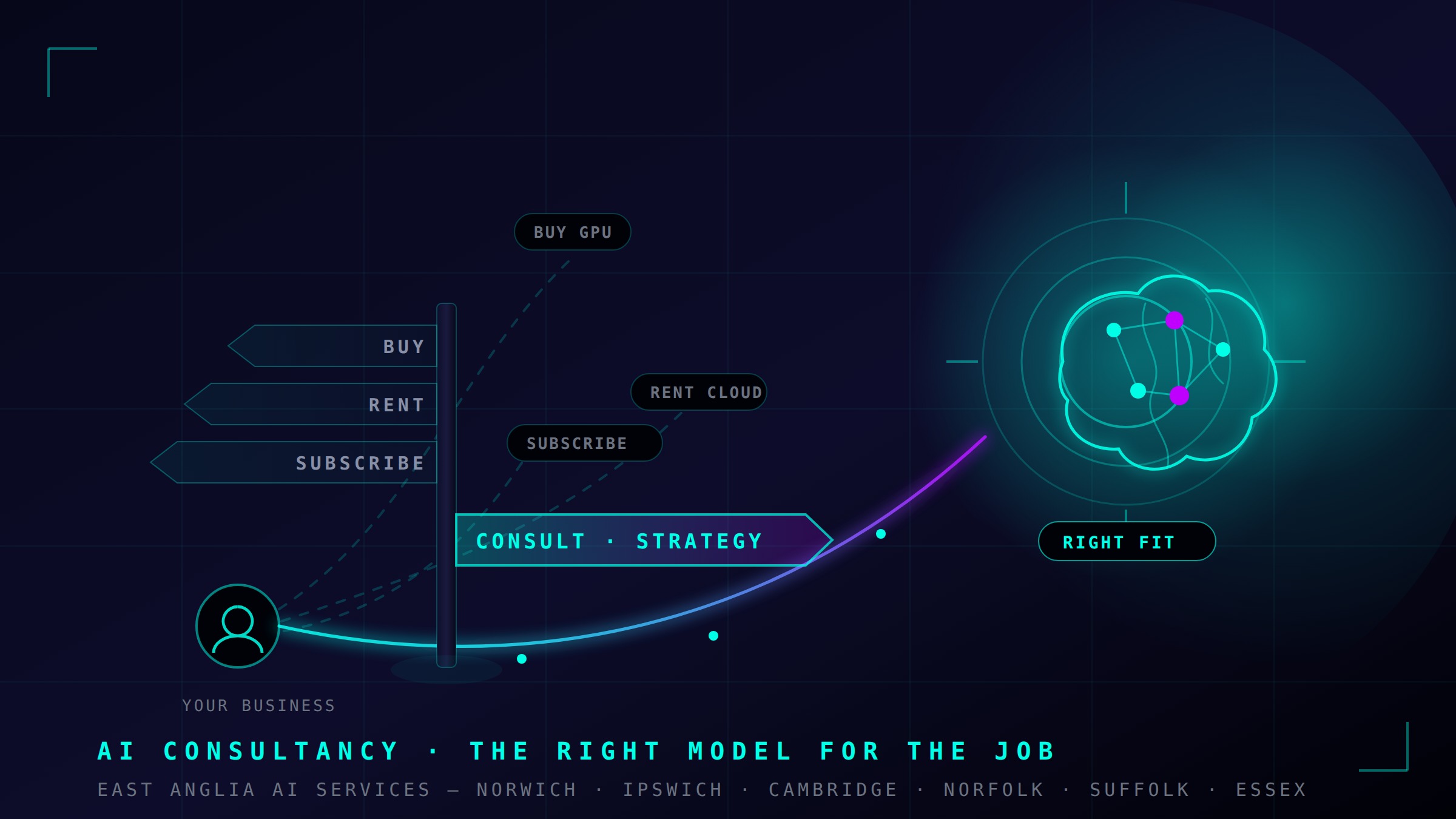
Most owners come to artificial intelligence the same way they'd come to any other purchase: they go looking for the best one. They open a dozen browser tabs, read a leaderboard or two, compare the monthly prices, and try to work out whether they should be paying for this model or that one, buying a machine to run it on, or signing up to a subscription. It feels like the responsible thing to do. The trouble is that it starts from the wrong end, and for a small business in Norwich, Ipswich or Cambridge it's the quickest way to spend money on the wrong thing.
The honest answer, and the one you'll rarely hear from anyone selling a product, is that "which is the best AI model" is almost never the question that matters. A short conversation with someone who does this for a living will save most firms more than any amount of comparison shopping, because it changes the question you're answering in the first place. This is the case for talking to an AI specialist before you buy, rent or subscribe to anything.
Why "the best AI model" is a moving target
Set aside the marketing and the field looks less like a shelf of products and more like a fast-flowing river. The models leapfrog each other constantly; whichever one tops the charts this quarter is unlikely to be top by the next. Stanford University's closely watched annual review of the field found that the cost of running a model at the level of 2022's ChatGPT fell more than 280-fold in under two years, from roughly $20 per million words of output to about $0.07, as the underlying hardware and software grew dramatically more efficient (Stanford University, 2025). Over the same period the freely available "open-weight" models all but caught the closed commercial ones, closing the performance gap on some standard tests from 8% to under 2% in a single year (Stanford University, 2025).
Read that carefully and a useful conclusion falls out. The model itself is becoming the cheap, fast-moving part of the equation. Capability is flooding the market and prices are collapsing, which means the thing you'd agonise over choosing today may be surpassed, or undercut, within months. The expensive part is no longer the model. It's the decision about how to use it, what to feed it, and how the whole arrangement fits the way your business actually works. That part doesn't fall in price, and it doesn't sort itself out by picking whatever sits at the top of a leaderboard.
Buy, rent, subscribe: three answers to the wrong question
When a firm decides it wants AI, the choice usually gets framed as a shopping decision with three doors. It's worth being plain about what each one really is, because they're often blurred together in the pitch.
Subscribing means paying a provider a monthly fee, per person or per use, to reach a hosted model over the internet — the ChatGPT, Claude or Gemini route. It's the fastest way to start, it needs no hardware, and it usually puts the strongest raw models at your fingertips. Renting means paying for computing power, typically a graphics processor in a data centre, so you can run a model of your choosing with more control and scale than a consumer subscription allows, without owning the kit. Buying means putting the hardware under your own roof, or in space you control, and running a model in-house so that nothing you type has to leave the building.
Each of these is a perfectly sensible answer to a specific situation. The mistake is treating the choice between them as the main event. Buying, renting and subscribing are procurement decisions, and you can only make a procurement decision well once you know what you're actually trying to do. Lead with the product and you're guessing. That's how a firm ends up subscribing thirty staff to a premium tool most of them barely touch, or buying a graphics card for a job a cheap hosted call would have handled, or renting cloud compute to run a model that a modest office machine could run for nothing.
What leading with the product actually costs you
The bill for choosing badly rarely shows up as one obvious mistake. It arrives quietly, in a few recognisable shapes. There's the tool nobody uses — bought or subscribed to on the strength of a demonstration, then left to gather dust because it never fitted the way the work is really done. There's the recurring cost that creeps: a per-seat subscription is trivial for one person and a serious line item across a whole team, especially for tasks a smaller, cheaper model would have managed. There's lock-in, where a business builds its habits around one provider's product and then finds the price, the terms or the model itself changing under its feet. And there's the mirror image of all of it — over-buying, spending on hardware and complexity for a problem that a simple subscription would have solved in an afternoon.
None of these is a failure of the technology. The models are, by and large, remarkably good. They're failures of sequencing — of deciding how to buy before deciding what the job is. It isn't a coincidence that hesitation runs so deep among the owners who feel this most keenly. The Federation of Small Businesses found that 92% of small business owners worry about the risks of AI, from accuracy to security to where their data ends up (Federation of Small Businesses, 2026). A lot of that worry is really the fear of committing to the wrong thing, and it's exactly the fear a proper conversation is there to settle.
What a consultation changes
A consultation with an AI specialist inverts the order of the whole exercise. Instead of starting with a model and looking for a use, it starts with the work and looks for the fit. The questions come before the products, and they're unglamorous ones. Which tasks are genuinely costing you time or money right now? How sensitive is the information those tasks touch? What volumes are we talking about — a handful of documents a week, or thousands a day? What's the budget, and what are your obligations under data protection law? Only once those answers are on the table does the buy, rent or subscribe question even make sense, and by then it usually answers itself.
That last point about obligations matters more than it looks. Whatever route you take, the Information Commissioner's Office is clear that you remain the data controller: you need a lawful basis, you should collect only what you need, you have to keep it secure, and you must be able to explain what the system does with the information (Information Commissioner's Office, 2023). A specialist keeps that in view from the start, so the arrangement you end up with is one you can actually stand behind, rather than one you have to unpick later.
The other thing a good adviser brings is neutrality. Because the best model changes month to month, useful advice is almost never "buy this one product". It's a way of choosing that still holds up when the models move on, which they always do. An independent specialist has no reason to push you toward a subscription you don't need or hardware you won't use. The recommendation that comes back is often a blend — a hosted model for general work, something private for the sensitive jobs, and nothing at all for the tasks where AI simply isn't the answer. That kind of honest mixture is very hard to reach on your own, and almost impossible to reach from a vendor's website.
Where this pays off across East Anglia
The value of getting the question right isn't abstract, and it isn't reserved for big firms with technology departments. Across Norfolk, Suffolk, Cambridgeshire and Essex, the same pattern shows up again and again, in ordinary businesses with ordinary problems.
A professional services firm in Norwich sitting on years of confidential files doesn't need the flashiest chatbot; it needs to know which tasks can safely use a hosted model and which ought to stay in-house, and how to draw that line without falling foul of its obligations. A retailer in Ipswich drowning in similar customer questions doesn't need to buy anything heavy; it needs the right small model pointed at the right job, at a running cost that makes sense for its margins. A Cambridge scale-up moving fast might genuinely benefit from rented compute and a model it controls, but only once someone has checked that the volumes justify it. A trades business in rural Norfolk, or a logistics operator in Essex, may find that the answer is far simpler and far cheaper than the pricing pages suggested. In every one of these cases, the money is saved not by finding a better model, but by asking a better question first — and a local specialist who knows the region and can sit across the table tends to get to that question faster.
It's worth remembering why this gap persists. The Office for National Statistics found that while around 44% of large firms had adopted AI by late 2025, smaller businesses were trailing at roughly 26% (Office for National Statistics, 2025). That gap has never really been about the technology being out of reach — the same models are available to a firm in Lowestoft as to one in London. It's about knowing which tool fits which job, and that knowledge is precisely what a consultation exists to supply.
The honest limits — when you don't need us
It would be a poor argument for consultation if it claimed everyone needs one, so let's be straight about when you don't. If you're a sole trader who wants help drafting the odd email, or a small team doing light, low-stakes work with nothing sensitive involved, then a standard subscription is very likely the right call and you don't need anyone's permission or advice to press start. Use it, and use it without guilt. The point of talking to a specialist isn't to insert a gatekeeper in front of tools that are meant to be easy. It's to stop you committing real money, real hardware or real risk to the wrong choice — and if none of those are on the table, there's not much to get wrong.
A consultation earns its place the moment the stakes rise: when the data is confidential or regulated, when the volumes are high enough that running costs matter, when you're weighing a hardware purchase, or when a decision would be genuinely awkward to reverse. Those are the situations where a couple of hours of clear thinking pays for itself many times over, and where guessing is expensive.
How a sensible AI decision actually starts
The approach that works is unremarkable, which is rather the point. It looks less like shopping and more like a short piece of diagnosis, and it's the same shape whatever the eventual answer turns out to be:
- Start with the problem, not the product — write down the one or two tasks that are genuinely costing you time or money today, and be specific about them.
- Understand the data before you understand the tools — decide which information is sensitive or regulated, because that single fact shapes almost everything that follows.
- Prove it on the cheapest thing that could work — a small trial on a hosted model or a modest local one usually tells you within days whether the idea has legs, before any real spending.
- Keep a person in the loop on anything that reaches a customer or carries risk, and write down how the data flows so your position under UK GDPR is clear from the outset.
- Only then decide whether to buy, rent or subscribe — and scale the commitment to the result the task has actually earned, not to the hype around it.
That's the whole of it. The firms across the region getting real value from AI aren't the ones who found the cleverest model or moved the fastest. They're the ones who asked what they were really trying to do before they reached for their card. A specialist's job is simply to help you ask that question well, and to make sure the answer — buy, rent, subscribe, or some careful mixture of all three — is the one that genuinely fits your business, rather than the one that happened to be top of the leaderboard the week you went looking.
Frequently asked questions
What does an AI consultant actually do?
A good AI consultant starts with your business rather than a product. They look at the specific jobs you want AI to help with, how sensitive the data is, the volumes involved, your budget and your legal obligations, and only then work out which approach fits — a hosted subscription, rented compute, an owned setup, or a mix. The value is in the diagnosis and the honest recommendation, not in selling you a particular tool. In practice it saves you from paying for the wrong thing.
Isn't it cheaper to just subscribe to ChatGPT and skip the consultation?
For a single person doing light, low-risk work, a subscription is often exactly right, and you don't need advice to start. It stops being the cheap option once you scale it across a team, feed it sensitive data, or discover a smaller local model would have done the job for a fraction of the running cost. A short consultation is cheap insurance against committing to a monthly bill, or a piece of hardware, that turns out to be the wrong fit.
Buy, rent or subscribe — which is right for a small business?
There is no single answer, because each suits a different job. Subscribing to a hosted model is the fastest, lowest-commitment start and usually gives you the strongest raw model. Renting compute makes sense when you need control or scale without owning hardware. Buying and running a model in-house wins on privacy, predictable cost at high volume, and offline reliability. Most firms end up with a sensible blend, which is precisely what a consultation is for — matching the option to the task rather than picking one on principle.
Do AI consultants recommend specific vendors or models?
An independent consultant should be vendor-neutral: they recommend whatever genuinely fits your problem, whether that is a well-known hosted model, an open-weight model you run yourself, or a combination. Because the best model on any given month changes, the useful advice is rarely "buy this one product" — it is a way of choosing that still holds up when the models move on, which they always do.
Not sure whether to buy, rent, subscribe — or none of the above?
We'll look at your tasks, your data and your budget, and tell you honestly which approach fits — on a free, no-pressure strategy call for businesses across Norfolk, Suffolk, Cambridgeshire and Essex.
Book a Free Strategy CallReferences
- Federation of Small Businesses (2026) Redefining Intelligence. London: FSB. Available at: https://www.fsb.org.uk/resources/policy-reports/redefining-intelligence-MCKHTFHSTCMVGF5BPKCDHVF73FGU (Accessed: 5 July 2026).
- Information Commissioner's Office (2023) Guidance on AI and data protection. Wilmslow: ICO. Available at: https://ico.org.uk/for-organisations/uk-gdpr-guidance-and-resources/artificial-intelligence/guidance-on-ai-and-data-protection/ (Accessed: 5 July 2026).
- Office for National Statistics (2025) Business insights and impact on the UK economy. Available at: https://www.ons.gov.uk/businessindustryandtrade/business/businessservices/bulletins/businessinsightsandimpactontheukeconomy/2october2025 (Accessed: 5 July 2026).
- Stanford University (2025) The 2025 AI Index Report. Stanford, CA: Stanford Institute for Human-Centered AI. Available at: https://hai.stanford.edu/ai-index/2025-ai-index-report (Accessed: 5 July 2026).