A conversation we have fairly often goes something like this. The owner of a small firm in Norwich or Ipswich says they haven't really done anything with AI yet. Twenty minutes later it turns out the office manager drafts most customer emails in ChatGPT, someone in accounts has been pasting supplier queries into a free chatbot on their phone, and the newest member of the team tidies up meeting notes with Copilot. Nobody was hiding it. Nobody had asked.
That isn't a criticism of anyone involved. People found a tool that saved them time and started using it, which is exactly what you'd hope staff would do. The trouble is what usually comes with it: no shared rules, no idea which tools are in use, and a team that has taught itself mostly by trial and error. Some of them are getting genuinely good results. Others are quietly getting it wrong, and there's no one in a position to notice.
The AI your business never chose
This pattern is far from unusual. When Microsoft and LinkedIn surveyed 31,000 people across 31 countries, they found that 75% of knowledge workers were already using AI at work. More telling, 78% of those users were bringing their own AI tools rather than waiting for their employer to provide them, and in small and medium-sized companies the figure rose to 80% (Microsoft and LinkedIn, 2024). The same report found that only 39% of people using AI at work had received any training on it from their company.
Put those two numbers side by side and you have the real position in a lot of offices across the region. Plenty of use, very little guidance. Staff are picking whatever tool they happened to sign up for, working out what it can do as they go, and forming habits that nobody has looked at.
The government has noticed the gap too. In June 2025 the Department for Science, Innovation and Technology announced a partnership with major technology firms to give 7.5 million UK workers AI skills training by 2030 (Department for Science, Innovation and Technology, 2025). In January 2026 that was widened into the AI Skills Boost programme, with free short online courses open to every adult and a new target of 10 million workers. Research published alongside the announcement found that only 21% of UK workers feel confident using AI at work (Department for Science, Innovation and Technology, 2026). Free courses are welcome, and we'd encourage staff to take them. But a general course can't tell your team what your client data rules are, which tools you've approved, or how to apply any of it to the jobs on their desk on a Monday morning.
Why training changes the results, not just the confidence
The most useful piece of research on this is a field experiment run by Harvard Business School and Boston Consulting Group with 758 of BCG's consultants. On tasks that sat comfortably within the AI's capabilities, consultants using GPT-4 completed 12.2% more tasks, finished them 25.1% more quickly and produced work rated more than 40% higher in quality than a control group working without it. On a task deliberately chosen to sit just outside what the AI could do well, the picture flipped: consultants using AI were 19 percentage points less likely to reach the correct answer than those working alone (Dell'Acqua et al., 2023).
The researchers describe this as a "jagged technological frontier". The line between what AI handles well and what it gets wrong doesn't fall where you'd expect, and you can't see it by looking at how confident the answer sounds. That second finding is the one we'd want every team to hear. The tool didn't fail loudly. It produced fluent, well-structured answers that happened to be wrong, and highly capable professionals accepted them. Knowing roughly where the edges are, and getting into the habit of checking, is a skill. People can learn it, but they rarely learn it on their own.
There's a more encouraging side to the evidence as well. A large study of more than 5,000 customer support agents found that giving them an AI assistant raised the number of issues resolved per hour by around 15% on average. The biggest improvements went to newer and less experienced agents, who effectively picked up the working habits of their best colleagues much faster than they otherwise would have (Brynjolfsson, Li and Raymond, 2025). The point for a small business is that AI pays off most when it's used inside a clearly defined job, by people who know what good output looks like for that job. That's precisely what role-specific training sets out to build.
The risk nobody signed off
Then there's the data. If someone pastes a customer complaint, an employee's sickness record or a client's accounts into a free consumer chatbot, the business is still responsible for what happens to that information. Under the Information Commissioner's Office's guidance on AI, an organisation using personal data in AI systems remains accountable for it: it needs a lawful basis, it should use only what it needs, it has to keep that data secure and it must be able to explain what the system does with it (Information Commissioner's Office, 2023). Those duties are hard to meet when you don't know which tools your staff are using in the first place.
Owners are well aware of this. The Federation of Small Businesses (2026) found that 92% of small business owners worry about the risks of AI, with accuracy, security and where their data ends up high on the list. In our experience, worry without training tends to go one of two ways. Either there's a blanket ban that people work around on their own phones, or there are no rules at all. Neither is much of a plan. Training is the practical middle ground. It tells people which tools the business uses, what can go into them, what must never go into them, and when a person has to check the answer before it goes anywhere.
What useful AI training actually looks like
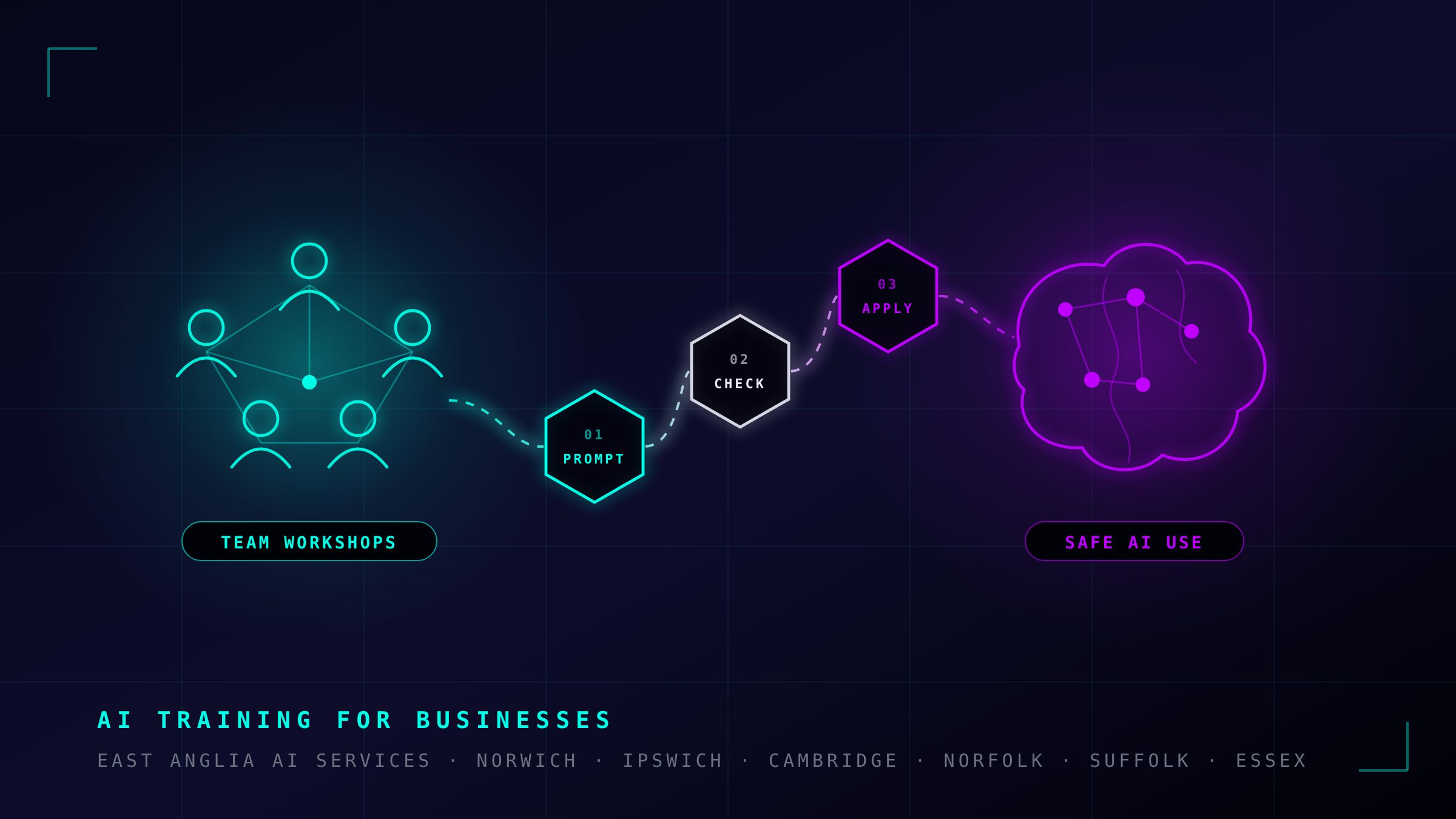
It isn't a one-hour webinar on the future of work. The sessions that make a lasting difference tend to have a few things in common:
- They're built on the team's own work. An office team at a Lowestoft logistics firm practises on its own delivery queries. An accountancy practice in Chelmsford works through real, anonymised client letters. People remember what they've done with their own material far better than a generic demo.
- They're hands-on from the start. Staff should have a keyboard in front of them within the first ten minutes, not a slide deck for an hour.
- They teach checking as much as prompting. Writing a good request is the easy part. Spotting an invented figure, a made-up reference or a confident answer to the wrong question is what protects the business.
- They set the house rules. Which tools are approved, what data stays out, and who signs off on anything that reaches a customer. Ideally that ends up written down as a short AI use policy, and our free AI Use Policy Generator is a quick way to draft one.
- They treat owners and managers separately. Leaders need a different conversation about where AI is worth the effort, what to measure and what it costs, rather than a lesson in prompt writing.
- They follow up. The best questions come a few weeks later, once people have tried things on real work and hit the awkward cases. A short check-in at that point is often worth more than the first session.
Where smaller firms fit in
The Office for National Statistics found that around a quarter of UK businesses were using some form of AI by late 2025, compared with 44% of businesses with 250 or more employees (Office for National Statistics, 2026). Large organisations have learning and development teams whose job is to roll this kind of thing out. A ten-person firm in King's Lynn or a family business outside Bury St Edmunds doesn't, and that's most of the difference. The tools cost the same for everyone. What smaller firms tend to lack is the time to work out how to use them properly, and someone to show their staff.
That's also why a modest amount of training goes a long way in a small business. When there are only a handful of people, one afternoon spent together on the tasks that eat everyone's week can change how the whole place works. It often makes more difference than another software subscription.
A sensible way to start
You don't need a transformation programme. A practical first pass looks something like this:
- Ask your team what they already use, and make it clear nobody is in trouble. You'll only get an honest answer if it's safe to give one.
- Write down some basic rules before anything else: approved tools, data that must never be entered, and when a human checks the output.
- Pick two or three tasks in each role that take up too much time, such as first drafts of routine emails, summarising long documents or tidying up notes.
- Train people on those tasks using real, anonymised material from your own business.
- Check back after a month. Find out what stuck, what didn't and where people got stuck.
If you'd like a quick read on where your business stands first, our free AI Readiness Assessment takes a couple of minutes. And if you want help putting the training together, that's exactly what our AI training for businesses is for. We run it on-site across Norfolk, Suffolk, Cambridgeshire and Essex, or remotely anywhere in the UK.
None of this needs a big budget. It needs someone to sit down with your team, look at the work they actually do, and show them how to get the useful part of these tools while leaving the risky part behind. Most of your staff have already started on their own. They'd probably appreciate a hand.
Frequently asked questions
Do my staff need technical skills to get something out of AI training?
No. Good AI training for a business team is about the work people already do: writing, summarising, answering customers, checking figures. If someone can write an email and use a spreadsheet, they have all the background they need. The technical side is our job, not theirs.
How long does AI training take?
Most teams get real value from a single half-day or full-day hands-on session built around their own tasks, followed by a shorter check-in a few weeks later once they've tried things on real work. Leadership briefings are usually shorter. There's no need to take people away from the business for a week.
Isn't the free government AI training enough?
The free AI Skills Boost courses are a decent introduction to the basics, and we'd happily point staff towards them. What they can't do is cover your tools, your data rules and your actual tasks. Training built around your own work is what turns general awareness into habits people use every day.
Will AI training make my business UK GDPR compliant?
Not on its own. You remain the data controller, so the usual UK GDPR duties still apply. What training does is make sure staff know which tools are approved, what information must never go into them and when a person has to check the output, which makes those duties far easier to meet in practice.
Want your team using AI safely and well?
We run hands-on AI training built around your own work, for businesses across Norfolk, Suffolk, Cambridgeshire and Essex. It starts with a free, no-pressure strategy call.
References
- Brynjolfsson, E., Li, D. and Raymond, L. (2025) 'Generative AI at work', The Quarterly Journal of Economics, 140(2), pp. 889-942. Available at: https://doi.org/10.1093/qje/qjae044 (Accessed: 8 October 2026).
- Dell'Acqua, F., McFowland III, E., Mollick, E.R., Lifshitz-Assaf, H., Kellogg, K., Rajendran, S., Krayer, L., Candelon, F. and Lakhani, K.R. (2023) Navigating the jagged technological frontier: field experimental evidence of the effects of AI on knowledge worker productivity and quality. Harvard Business School Working Paper 24-013. Boston, MA: Harvard Business School. Available at: https://papers.ssrn.com/sol3/papers.cfm?abstract_id=4573321 (Accessed: 8 October 2026).
- Department for Science, Innovation and Technology (2025) Tech giants join government to kick off plans to boost British worker AI skills. London: DSIT. Available at: https://www.gov.uk/government/news/tech-giants-join-government-to-kick-off-plans-to-boost-british-worker-ai-skills (Accessed: 8 October 2026).
- Department for Science, Innovation and Technology (2026) Free AI training for all as government and industry programme expands to provide 10 million workers with key AI skills by 2030. London: DSIT. Available at: https://www.gov.uk/government/news/free-ai-training-for-all-as-government-and-industry-programme-expands-to-provide-10-million-workers-with-key-ai-skills-by-2030 (Accessed: 8 October 2026).
- Federation of Small Businesses (2026) Redefining Intelligence. London: FSB. Available at: https://www.fsb.org.uk/resources/policy-reports/redefining-intelligence-MCKHTFHSTCMVGF5BPKCDHVF73FGU (Accessed: 8 October 2026).
- Information Commissioner's Office (2023) Guidance on AI and data protection. Wilmslow: ICO. Available at: https://ico.org.uk/for-organisations/uk-gdpr-guidance-and-resources/artificial-intelligence/guidance-on-ai-and-data-protection/ (Accessed: 8 October 2026).
- Microsoft and LinkedIn (2024) 2024 Work Trend Index annual report: AI at work is here. Now comes the hard part. Redmond, WA: Microsoft. Available at: https://www.microsoft.com/en-us/worklab/work-trend-index/ai-at-work-is-here-now-comes-the-hard-part (Accessed: 8 October 2026).
- Office for National Statistics (2026) Business insights and impact on the UK economy: 8 January 2026. Newport: ONS. Available at: https://www.ons.gov.uk/businessindustryandtrade/business/businessservices/bulletins/businessinsightsandimpactontheukeconomy/8january2026 (Accessed: 8 October 2026).